
Asset Management Solutions for a More Complex Revenue Environment
Listen to this article
What Are Asset Management Solutions?
Asset management solutions are the technology platforms, systems, and processes that help investment managers operate their business more effectively. They support everything from portfolio management and fund administration to client reporting, compliance, operations, fee billing, and business performance.
Historically, these solutions focused on managing investments and supporting operational workflows. Portfolio accounting systems tracked holdings, fund accounting platforms managed valuations, CRMs supported client relationships, and billing systems calculated management fees. Each system served a specific purpose, often operating independently from the others.
Today's asset management firms, however, require more than operational efficiency.
Revenue Has Become the New Operational Challenge
Asset management firms are operating in a market where revenue is harder to manage, harder to explain, and harder to protect.
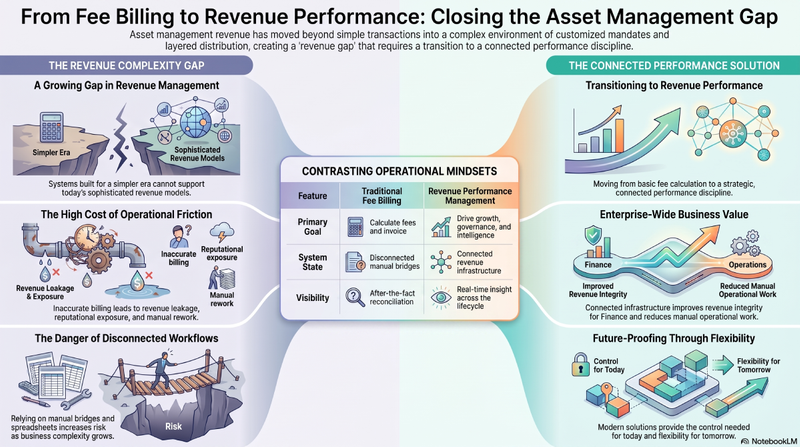
Fee schedules are more complex. Mandates are more customized. Distribution relationships are more layered. Institutional clients expect greater transparency. Regulatory expectations continue to rise. And internal teams are often asked to support increasingly sophisticated revenue models with systems and processes that were built for a simpler era.
The result is a growing gap between the way asset managers generate revenue and the way many firms manage it.
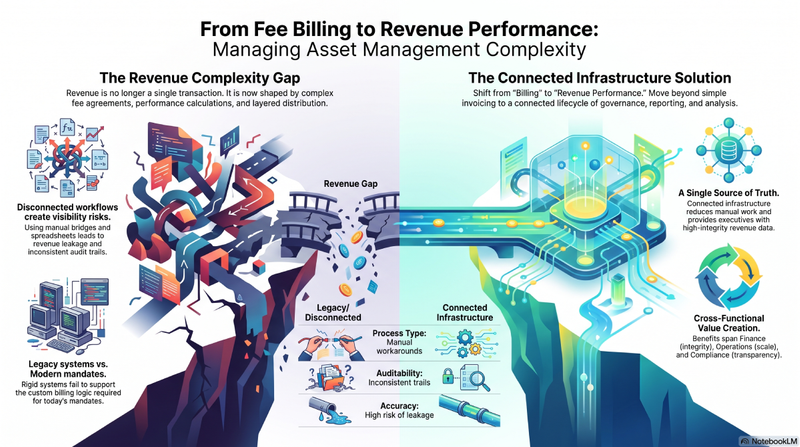
For asset managers, revenue is not a single transaction. It is shaped by fee agreements, account structures, performance calculations, distribution arrangements, client terms, billing rules, expense treatment, compensation models, reporting requirements, and governance controls. When those elements are managed across disconnected workflows, even strong firms can lose visibility, consistency, and confidence.
That is why enterprise asset management solutions need to do more than support back-office processing. They need to help firms manage revenue as a connected performance discipline.
The Revenue Challenge for Asset Managers
Asset managers face a distinct set of revenue management challenges.
Pricing is rarely one-size-fits-all. Fee structures can vary by client, product, mandate, channel, asset class, household, jurisdiction, or negotiated agreement. Institutional relationships may include custom terms. Intermediary and wealth channels may introduce additional complexity. New products and strategies can require new billing logic. Legacy systems may not be flexible enough to keep pace.
At the same time, firms must maintain high levels of accuracy, transparency, and auditability.
A billing issue is not just an operational inconvenience. It can create client frustration, reputational exposure, revenue leakage, manual rework, and unnecessary pressure on finance, operations, and client-facing teams.
Asset managers need solutions that help them manage this complexity without adding more friction.
What Modern Asset Management Solutions Should Deliver
The best asset management solutions help firms connect strategy, revenue execution, governance, and intelligence.
They should allow firms to calculate fees accurately, manage complex billing rules, support client-specific arrangements, reduce manual intervention, improve exception handling, and maintain a trusted view of revenue across the business.
But the value should go beyond calculation.
Modern solutions should help asset managers understand where revenue is at risk, where pricing rules are inconsistent, where exceptions are increasing, and where operational complexity is creating avoidable cost. They should provide the control needed for today’s revenue environment and the flexibility needed for tomorrow’s.
In other words, asset management solutions should not simply help firms process revenue.
They should help firms manage revenue better.
From Fee Billing to Revenue Performance
For many asset managers, fee billing has historically been treated as an operational function. The goal was to calculate the right fee, invoice the client, reconcile the result, and resolve any exceptions.
That work remains essential.
But fee billing now sits inside a much larger revenue performance challenge. Firms need to understand how fees are structured, how they are governed, how exceptions are approved, how revenue is captured, how pricing decisions affect margin, and how leaders can trust the numbers used to make strategic decisions.
This shift changes the role of technology.
A modern asset management solution should provide the infrastructure to support complex revenue models with accuracy and control. It should also give leaders better visibility into the revenue lifecycle, from pricing and calculation through collection, reporting, governance, and analysis.
That is the difference between managing a billing process and managing revenue performance.
Why Connected Revenue Infrastructure Matters
Disconnected systems make revenue harder to manage.
When fee schedules, client terms, billing data, revenue reporting, and governance workflows live in separate places, firms are forced to rely on manual bridges. Spreadsheets, one-off checks, institutional knowledge, and after-the-fact reconciliations become part of the operating model.
That may work for a while. But as the business becomes more complex, the risk grows.
Manual work increases. Exceptions become harder to track. Audit trails become less consistent. Reporting takes longer. Leaders have less confidence in whether revenue is being captured accurately and managed effectively.
Connected revenue infrastructure gives asset managers a better foundation.
It creates a more consistent source of truth for revenue activity. It helps teams apply rules more accurately. It supports stronger governance. It reduces dependency on manual processes. And it gives executives better insight into performance, risk, and opportunity.
The Business Value of Better Asset Management Solutions
Better asset management solutions create value across the firm.
For finance leaders, they improve revenue integrity, reduce leakage, and strengthen confidence in revenue reporting.
For operations leaders, they reduce manual work, improve control, and make complex billing processes easier to manage at scale.
For compliance and risk teams, they support greater auditability, transparency, and consistency.
For client-facing teams, they reduce billing noise and create greater confidence in the accuracy and explainability of client revenue activity.
For executives, they provide a clearer view of how revenue is being managed across products, clients, channels, and business lines.
That cross-functional value is critical. Revenue does not belong to one department. It touches the entire firm.
Supporting the Next Era of Asset Management
The asset management industry will only become more complex.
Firms will continue to launch new products, customize client relationships, expand distribution models, evolve pricing structures, and operate under greater scrutiny. The firms best positioned for this environment will be the ones that can manage revenue with accuracy, flexibility, governance, and intelligence.
That requires asset management solutions built for the realities of the industry.
Not generic billing tools. Not disconnected reporting layers. Not manual workarounds hidden behind legacy processes.
Asset managers need solutions that understand the complexity of revenue and provide the infrastructure to manage it with confidence.
Because in asset management, revenue performance depends on more than what a firm earns.
It depends on how well that revenue is calculated, captured, governed, explained, and improved.
FAQs
What are asset management solutions?
Asset management solutions are software platforms and technologies that help investment managers oversee portfolios, client relationships, fee structures, operations, compliance, and reporting. Modern solutions increasingly extend beyond portfolio management to support Revenue Performance Management, helping firms manage pricing, billing, governance, and revenue intelligence across the entire revenue lifecycle.
What are asset management client solutions?
Asset management client solutions are the tools and services firms use to deliver personalized investment experiences, reporting, pricing, billing, and ongoing relationship management. Connected platforms allow firms to support customized fee arrangements while improving transparency and operational efficiency across every client relationship.
What are the top asset management solutions for businesses in Canada?
The best asset management solutions depend on a firm's size, operating model, and complexity. Smaller Canadian investment firms often prioritize scalable cloud platforms that simplify operations while supporting future growth. As firms mature, solutions that integrate fee billing, revenue governance, analytics, and Revenue Performance Management can provide greater long-term value than standalone operational tools.
What are the core components of an effective asset management strategy?
An effective asset management strategy combines investment management, client service, pricing, fee administration, governance, operational efficiency, and performance measurement. Leading firms also treat revenue as a strategic discipline by connecting pricing, billing, analytics, and decision-making through Revenue Performance Management.
Which asset management platforms offer cloud-based services?
Many modern asset management platforms are delivered through secure cloud architectures, giving firms greater scalability, flexibility, and easier access to new capabilities. PureFacts delivers its Revenue Performance Management platform through a modern cloud-based architecture that helps wealth and asset management firms manage complex fee billing, compensation, practice management, and revenue intelligence without relying on disconnected legacy systems.
Why are traditional asset management systems no longer enough?
Many legacy platforms were designed to support portfolio administration or operational workflows rather than the complete revenue lifecycle. As pricing models, distribution relationships, and client agreements become more complex, firms increasingly require connected solutions that improve revenue governance, transparency, and operational control.
How do asset management solutions improve revenue accuracy?
Modern asset management solutions automate complex fee calculations, apply pricing rules consistently, reduce manual intervention, and improve exception management. This helps firms reduce revenue leakage, strengthen billing accuracy, and build greater confidence in financial reporting.
What is Revenue Performance Management for asset managers?
Revenue Performance Management is the practice of designing, executing, governing, measuring, and continuously optimizing the revenue lifecycle. For asset managers, it connects pricing, fee billing, compensation, analytics, and governance to improve profitability while reducing operational complexity.
How can asset managers reduce revenue leakage?
Reducing revenue leakage starts with improving visibility into pricing agreements, billing rules, revenue calculations, and operational exceptions. Platforms like PureFacts help firms centralize commercial data, automate revenue workflows, and identify opportunities to improve revenue integrity before issues affect financial performance.
What should firms look for in enterprise asset management solutions?
Enterprise asset management solutions should support flexible fee structures, institutional pricing, complex billing rules, governance, auditability, analytics, and integration with existing investment operations. They should also provide the visibility needed to manage revenue performance across products, clients, channels, and business lines.
Why is connected revenue infrastructure important for asset managers?
Connected revenue infrastructure brings together pricing, billing, client agreements, governance, analytics, and reporting into a unified operating model. This reduces manual reconciliation, improves auditability, strengthens decision-making, and gives firms a more complete view of revenue performance across the business.