
Revenue Integrity Explained: A Guide for Wealth Management Firms
Listen to this article
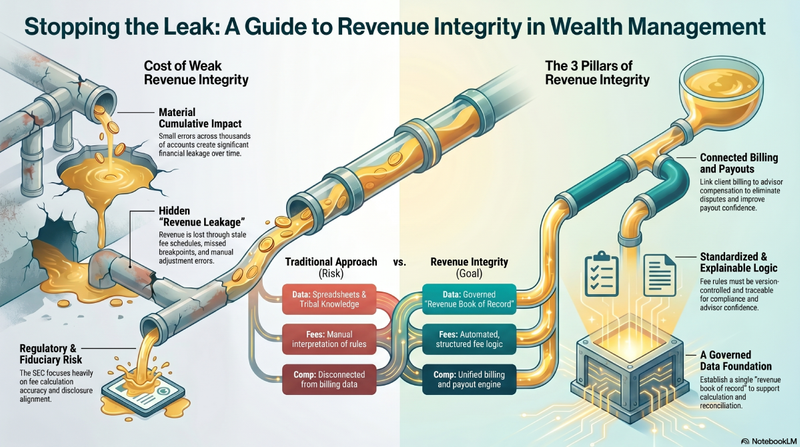
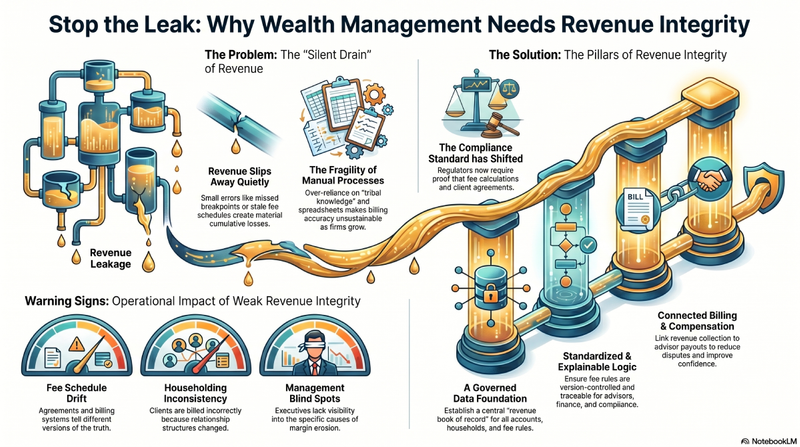
For many wealth management firms, revenue does not disappear in dramatic fashion. It slips away quietly. A stale fee schedule stays active after a new client agreement is signed. A household breakpoint is missed. A discount is approved by an advisor but not reflected consistently across billing, reporting, and compensation. A manual adjustment fixes one invoice but creates a downstream payout issue.
No single error looks catastrophic. Across thousands of accounts, billing periods, advisors, products, custodians, and exceptions, the cumulative impact becomes material. That is the problem Revenue Integrity is designed to solve. In wealth and asset management, the revenue lifecycle has become too complex to manage through disconnected systems, spreadsheets, tribal knowledge, and periodic clean-up projects. Firms need a disciplined way to ensure that the revenue they earn is the revenue they calculate, collect, distribute, report, and govern.
What is Revenue Integrity?
Revenue Integrity is the discipline of ensuring that a wealth or asset management firm accurately captures, calculates, collects, distributes, and reports the revenue it has earned. It connects fee billing, advisor compensation, data reconciliation, controls, and reporting so revenue is complete, explainable, and governed across the full revenue lifecycle.
Put simply, Revenue Integrity makes sure every dollar is treated correctly from the moment it is defined in a client agreement to the moment it appears in financial reporting, advisor compensation, and executive decision-making. For wealth firms, this is not a generic finance concept. It is a direct response to the operational reality of advisory fees, complex pricing arrangements, householding rules, breakpoints, billing exclusions, credits, rebates, compensation plans, and client transparency expectations.
Why Revenue Integrity matters for wealth management firms
Fee billing complexity creates revenue leakage
Fee billing in wealth management is rarely as simple as applying one rate to one account balance. Most firms operate across multiple account types, billing frequencies, advisory programs, asset classes, custodians, products, fee schedules, and client-level exceptions. One relationship may include several accounts, negotiated pricing, household-level breakpoints, excluded assets, legacy terms, and advisor-specific arrangements.
When these rules are managed in separate systems or manually interpreted across teams, billing accuracy becomes fragile. A rule may be correct in the contract but wrong in the billing engine. A discount may be known to the advisor but invisible to finance. A breakpoint may be applied in one system but not reconciled against household structure in another. Revenue Integrity helps firms move from 'we believe billing is generally accurate' to 'we can prove how revenue was calculated, why it was calculated that way, and where every exception came from.'
Revenue accuracy is a compliance and governance issue
Advisory fees are part of the client promise, not just an operational output. For RIAs, broker-dealers, wealth managers, and asset managers, fee calculation errors can create fiduciary, disclosure, books and records, and supervisory concerns. Regulators have repeatedly highlighted advisory fee and expense issues, including incorrect fee calculations, billing practices that do not match agreements or disclosures, incorrect application of discounts or rebates, and weaknesses in policies and procedures.
That changes the standard. The issue is not only whether the firm can generate invoices. The issue is whether the firm can demonstrate that fee calculations match client agreements, disclosures, policies, and actual business practices. Revenue Integrity creates the operating discipline for that chain of evidence, from source data to calculation logic to billing output to client reporting, accounting, and compensation.
Advisor compensation depends on trusted revenue data
Revenue Integrity does not end when a fee is collected. In many wealth firms, fee billing and advisor compensation are deeply connected but operationally separated. Billing determines the revenue coming into the firm. Compensation determines how that revenue is distributed to advisors, teams, branches, channels, and referral partners.
If the underlying revenue data is incomplete, late, inconsistent, or corrected after the fact, compensation becomes harder to trust. Advisors spend time challenging statements, escalating exceptions, and validating what should already be clear. When billing, collections, adjustments, credits, write-offs, and compensation logic are connected through a consistent revenue book of record, firms can reduce disputes, improve payout confidence, and align incentives with pricing strategy.
Common problems when Revenue Integrity is weak
The signs of weak Revenue Integrity are familiar to operations and finance teams. They often appear as normal business friction until the firm quantifies the impact.
One common issue is fee schedule drift. The firm may negotiate new pricing with a client, but the operational fee schedule is not updated everywhere it needs to be. Over time, the agreement, billing system, CRM, advisor notes, and reporting environment begin to tell different versions of the truth.
Another issue is manual exception dependency. A billing team may know exactly how to handle a complex client relationship, but the process depends on a person remembering the rule, editing a spreadsheet, or applying an adjustment outside the system. That may work when volume is low. It becomes risky as the firm grows, acquires books, introduces new pricing models, or changes compensation plans.
Householding and breakpoint inconsistency can create similar problems. Many wealth firms offer pricing based on relationship size, but household structures change. Accounts are opened, closed, transferred, split, merged, or reclassified. If householding logic is not governed across systems, clients may be billed incorrectly and advisors may receive compensation based on an incomplete view of the relationship.
Poor reconciliation between billing and accounting is another warning sign. Billing teams may focus on fee calculation, finance may focus on recognized revenue, and operations may focus on exceptions and corrections. If there is no shared revenue data model, each group builds its own reconciliation process. That creates delay, duplication, and uncertainty.
Finally, weak Revenue Integrity often creates management blind spots. Executives may see revenue results at the aggregate level but lack visibility into the causes behind margin erosion. They may not know how much revenue is being lost to leakage, how much discounting is unmanaged, which advisors are protecting price, or which processes are creating recurring credits and write-offs.
What good Revenue Integrity looks like
Good Revenue Integrity starts with a simple premise: revenue should have one trusted operating truth. That does not mean every system must be replaced at once. It means the firm needs a governed way to connect the data, rules, workflows, controls, and reporting that determine how revenue moves through the business.
1. A governed revenue data foundation
The firm needs reliable data across accounts, households, clients, advisors, products, assets, fee schedules, agreements, billing events, adjustments, and compensation rules. Data quality is not an abstract technology concern. It determines whether revenue is calculated correctly and whether teams can trust the output. The goal is to create a revenue book of record that can support calculation, reconciliation, reporting, compliance, and decision-making.
2. Standardized and explainable fee logic
Fee rules should be structured, version-controlled, and consistently applied. That includes rates, tiers, breakpoints, exclusions, billing frequencies, proration rules, discounts, rebates, credits, and termination rules. Operations should be able to trace the calculation. Finance should be able to reconcile the result. Compliance should be able to review the policy. Advisors should be able to explain fees with confidence.
3. Automated controls and exception management
Automation should reduce manual intervention, but it should also improve control. Strong Revenue Integrity requires exception workflows that capture approvals, document rationale, preserve audit history, and prevent one-off workarounds from becoming invisible operating practice. The better question is not 'Can we automate billing?' It is 'Can we automate billing while increasing accuracy, transparency, and governance?'
4. Connected billing, compensation, and executive visibility
Fee billing and advisor compensation should not operate as separate worlds. The revenue collected from clients and the revenue distributed to advisors must be connected through consistent logic and reliable data. When they are connected, firms can reduce disputes, improve payout confidence, and better understand how advisor behavior affects revenue performance.
Revenue Integrity should also give leaders better visibility into the business. CFOs need confidence in revenue accuracy, leakage reduction, and margin protection. COOs need scalable processes with fewer breaks and stronger controls. Technology leaders need architecture that reduces system fragmentation. Compliance leaders need evidence that policies, agreements, disclosures, and billing practices are aligned.
How to approach Revenue Integrity without boiling the ocean
The best starting point is not a massive transformation program. It is a targeted assessment of where revenue risk and revenue opportunity are most concentrated.
For many firms, that means mapping the current revenue lifecycle from client agreement to fee calculation, billing, collection, adjustment, compensation, accounting, reporting, and audit. The objective is to identify where data changes hands, where rules are interpreted manually, where exceptions accumulate, where reconciliations occur, and where teams lack confidence in the numbers.
From there, firms can prioritize the highest-value use cases: reducing billing errors and revenue leakage, standardizing fee schedules and pricing rules, improving householding and breakpoint accuracy, automating exception review, connecting billing and compensation data, improving audit readiness, and giving CFOs and COOs better revenue visibility.
Technology and automation can play an important role. But the technology should serve the operating discipline, not the other way around. Revenue Integrity is not achieved by installing another point solution. It requires connected infrastructure, governed data, configurable rules, and shared visibility across the teams responsible for revenue performance.
Revenue Integrity turns hidden friction into measurable performance
Wealth and asset management firms are already under pressure from fee compression, rising client expectations, regulatory scrutiny, advisor retention challenges, and margin pressure. In that environment, firms cannot afford to let earned revenue leak through operational gaps.
Revenue Integrity gives firms a practical way to protect what they have earned, reduce avoidable risk, strengthen advisor and client trust, and create a more scalable foundation for growth.
For firms ready to connect fee billing, advisor compensation, revenue intelligence, and governance across the full revenue lifecycle, PureFacts’ PureRevenue Platform is built to help turn Revenue Integrity into a measurable performance advantage.
FAQs
What is Revenue Integrity?
Revenue Integrity is the discipline of ensuring that every dollar a firm earns is accurately captured, calculated, collected, distributed, reconciled, and reported. In wealth management, Revenue Integrity connects fee billing, advisor compensation, revenue reconciliation, governance, and reporting to create a trusted revenue lifecycle. Rather than relying on disconnected systems and manual processes, firms can establish a single source of truth for revenue performance.
Why is Revenue Integrity Important?
Revenue Integrity helps wealth management firms reduce revenue leakage, improve billing accuracy, strengthen compliance, and increase confidence in financial reporting. As fee structures, household relationships, advisor compensation plans, and regulatory requirements become more complex, firms need a governed approach to managing revenue. Strong Revenue Integrity practices help protect margins while improving transparency for clients, advisors, operations teams, and executives.
How Can Firms Improve Revenue Integrity?
Improving Revenue Integrity starts with understanding where revenue risk exists across the revenue lifecycle. Firms should focus on standardizing fee schedules, improving data quality, automating billing and compensation workflows, strengthening reconciliation processes, and increasing visibility into revenue performance. Platforms like PureFacts' PureRevenue Platform help firms connect data, business rules, and workflows to create a more accurate and scalable revenue operating model.
What Software Solutions Are Best for Revenue Integrity Management?
The best Revenue Integrity solutions combine fee billing, revenue management, advisor compensation, reconciliation, reporting, and governance within a connected framework. Wealth management firms should look for platforms that provide configurable business rules, strong audit controls, automated workflows, and enterprise-grade reporting. PureFacts' PureRevenue Platform is purpose-built to help firms improve Revenue Integrity by creating a trusted revenue book of record across the entire revenue lifecycle.
What Are the Top Tools for Revenue Integrity Auditing and Compliance?
Effective Revenue Integrity auditing requires tools that provide transparency into fee calculations, billing exceptions, compensation adjustments, approvals, and reconciliation activities. Firms benefit from systems that maintain detailed audit trails, document policy enforcement, and support regulatory reviews. Revenue Integrity platforms that centralize revenue data and automate controls can significantly improve compliance readiness and reduce operational risk.
How Do Leading Platforms Automate Revenue Capture and Reconciliation?
Leading Revenue Integrity platforms automate the collection and validation of revenue-related data, apply billing and compensation rules consistently, reconcile activity across systems, and identify exceptions before they become larger issues. The goal is to reduce manual effort while improving accuracy, transparency, and control. In wealth management, firms increasingly seek platforms that connect billing, compensation, accounting, and reporting rather than managing each process separately.
Which Companies Offer Revenue Integrity Consulting Services?
Revenue Integrity consulting services are offered by a variety of management consulting firms, financial services specialists, and technology providers. The most effective partners combine industry expertise with practical experience in revenue operations, fee billing, compensation management, data governance, and technology implementation. PureFacts works with wealth and asset management firms to assess revenue performance, identify revenue leakage, and develop strategies that improve Revenue Integrity and operational efficiency.
What Does a Revenue Integrity Analyst Do?
A Revenue Integrity Analyst helps ensure revenue is calculated, processed, and reported accurately across the organization. Responsibilities often include reviewing fee calculations, reconciling revenue data, investigating exceptions, validating business rules, supporting audits, and identifying opportunities to reduce revenue leakage. In wealth management firms, Revenue Integrity analysts often work across operations, finance, compliance, and advisor compensation teams.
What Are the Signs of Weak Revenue Integrity?
Weak Revenue Integrity often shows up as billing errors, inconsistent fee schedules, manual workarounds, reconciliation challenges, compensation disputes, and limited visibility into revenue performance. Wealth management firms may also experience revenue leakage, audit difficulties, compliance risks, and reduced confidence in financial reporting. By implementing stronger controls, governed data, and connected revenue processes, firms can improve Revenue Integrity and ensure revenue is accurately calculated, collected, distributed, and reported across the entire revenue lifecycle.