
How Revenue Optimization Drives Organic Growth
Listen to this article
Organic growth has become harder to earn.
For wealth and asset management firms, the old growth equation is under pressure. Markets are more volatile. Fee pressure is persistent. Client expectations are rising. Advisors are being asked to grow relationships, defend value, and deliver better outcomes, often without the revenue intelligence they need to make better commercial decisions.
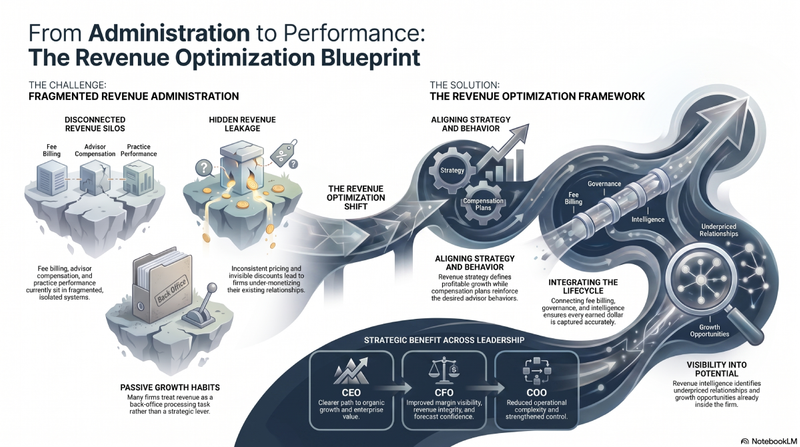
At the same time, many firms are still managing revenue through fragmented processes. Fee billing sits in one system. Advisor compensation sits in another. Practice performance is tracked somewhere else. Pricing decisions are often handled inconsistently across regions, books, or business lines. Exceptions pile up. Discounts become difficult to see. Leaders know the firm is growing, but they do not always know whether it is growing as profitably as it should.
That is the challenge revenue optimization is built to solve.
Revenue Optimization, Defined
Revenue optimization is the discipline of improving how a firm designs, captures, manages, and grows revenue across the full revenue lifecycle.
In wealth and asset management, that means connecting revenue strategy, fee billing, compensation, practice management, governance, and performance intelligence into a more deliberate system for organic revenue growth.
It helps firms answer a critical question:
Are we earning the revenue we should be earning from the clients, advisors, services, and relationships we already have?
For many firms, the answer is unclear. Not because they lack growth opportunities, but because they lack a connected view of where revenue potential exists, where revenue is being lost, and where advisor or firm behavior needs to change.
Revenue Optimization Starts With Revenue Strategy
Revenue optimization begins with revenue strategy.
Revenue strategy defines how a firm intends to grow revenue profitably. It determines how pricing should reflect value, which client segments deserve greater focus, how advisor behavior should be aligned, and where margin improvement can come from without simply asking the organization to sell more.
Without a clear revenue strategy, firms often default to inherited habits.
Discounts continue because they have always existed. Fee schedules multiply without clear governance. Advisor compensation plans reward activity without fully reinforcing the firm’s growth priorities. Reporting shows results after the fact, but does not guide better decisions in the moment.
Revenue strategy creates the commercial logic. Revenue optimization turns that logic into operating discipline.
Together, they help firms move from passive revenue administration to active revenue performance improvement.
Why Organic Revenue Growth Is So Hard
Most firms want stronger organic growth. The problem is that organic growth is not created by a single lever.
It depends on pricing discipline, advisor productivity, client expansion, retention, compensation design, billing accuracy, practice effectiveness, and executive visibility. If these elements are disconnected, growth becomes harder to manage and harder to repeat.
A firm may be adding assets, but still under-monetizing relationships.
It may be retaining clients, but carrying too many unnecessary discounts.
It may be paying advisors accurately, but not necessarily incentivizing the behaviors that improve firm-level profitability.
It may be billing correctly according to the data it has, but still missing revenue because the underlying rules, exceptions, or account structures are poorly governed.
This is why revenue optimization matters. It gives firms a way to improve organic revenue growth from the inside out.
Not by adding more pressure to advisors. Not by forcing blunt pricing changes. Not by treating revenue as a back-office processing issue.
But by creating better visibility, better alignment, and better control across the revenue lifecycle.
The Core Elements of Revenue Optimization
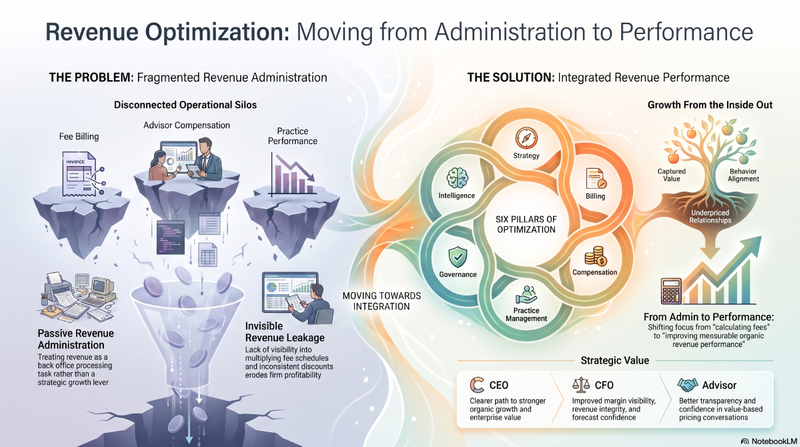
Revenue optimization brings together several connected capabilities.
- Revenue strategy sets the direction. It defines how the firm wants to grow, where pricing should improve, which behaviors should be encouraged, and how revenue performance should be measured.
- Fee billing ensures the firm accurately captures the revenue it has earned. This includes complex pricing rules, client arrangements, households, tiers, breakpoints, exclusions, discounts, approvals, and exceptions.
- Advisor compensation connects pay to performance. It helps firms align advisor incentives with the behaviors that support profitable growth, retention, pricing discipline, and client value.
- Practice management turns revenue intelligence into action. It helps leaders and advisors understand where practices are performing well, where revenue potential exists, and where better coaching or commercial guidance is needed.
- Governance creates control. It ensures that pricing, billing, compensation, and exceptions are transparent, auditable, and consistent.
- Revenue intelligence gives leaders the visibility to see what is happening, understand why it is happening, and act before small issues become larger performance gaps.
When these elements work together, revenue optimization becomes more than a finance or operations initiative. It becomes a growth capability.
Revenue Optimization Turns Existing Potential Into Measurable Growth
The most valuable organic growth opportunities are often already inside the firm.
They are hidden in underpriced relationships. In inconsistent discounting. In advisor books that could grow faster with better insight. In compensation plans that could better reinforce strategic priorities. In billing exceptions that quietly reduce revenue integrity. In client segments where the firm delivers strong value but does not fully capture it.
Revenue optimization helps firms find and act on those opportunities.
- For the CEO, it creates a clearer path to stronger organic growth and enterprise value.
- For the CFO, it improves margin visibility, revenue integrity, and forecast confidence.
- For the COO, it reduces operational complexity and strengthens control.
- For advisor-facing leaders, it provides better insight into practice performance and revenue potential.
- For advisors, it creates clearer guidance, better transparency, and more confidence in value-based pricing conversations.
This is the real promise of revenue optimization. It helps firms grow more efficiently by making the revenue they already have, and the relationships they already serve, work harder.
From Revenue Administration to Revenue Performance
For years, many firms have treated revenue as something to process after the commercial work is done.
Calculate the fee. Send the invoice. Pay the advisor. Produce the report. Fix the exception. Move on.
That model is no longer enough.
Revenue is too complex, too strategic, and too closely tied to organic growth to be managed as a set of disconnected administrative steps. Firms need a more integrated approach that connects strategy, execution, behavior, and intelligence.
That is what revenue optimization provides.
It helps wealth and asset management firms move from managing revenue activity to improving revenue performance.
And in a market where growth is harder, margins are tighter, and every basis point matters, that shift is no longer optional. It is quickly becoming one of the most important ways firms can improve organic revenue growth, strengthen profitability, and build a more scalable business.