
What Is Fee Management?
Listen to this article
For wealth and asset management firms, fee management sounds like a back-office function until it starts creating front-office problems.
A client receives a fee that does not match the agreement. A household breakpoint is missed. A negotiated discount is applied in one system but not another. A billing exclusion is interpreted differently by operations, finance, and the advisor. A compensation payout is questioned because the underlying fee data changed after the cycle closed. None of these issues may look material in isolation. Across thousands of accounts, advisors, products, custodians, and exceptions, they can quietly erode revenue, margin, trust, and confidence in the numbers.
That is why fee management has become more than a billing process. In modern wealth management, it is a core operating discipline for protecting revenue integrity, supporting advisor trust, reducing compliance exposure, and giving leaders more control over how revenue is earned, collected, and reported.
What is fee management?
Fee management is the process of defining, calculating, governing, collecting, reconciling, and reporting the fees a wealth or asset management firm earns from clients, accounts, portfolios, and investment mandates. In wealth management, fee management connects client agreements, pricing rules, billing operations, advisor compensation, compliance controls, and revenue reporting into one governed process.
Put simply, fee management ensures that the firm charges the right fee, to the right client, at the right time, under the right agreement, with a clear explanation of how the calculation was made.
Done well, it gives firms confidence that fees are accurate, explainable, audit-ready, and aligned with the commercial strategy of the business.
Why fee management matters for wealth management firms
Fee complexity is growing faster than manual processes can absorb
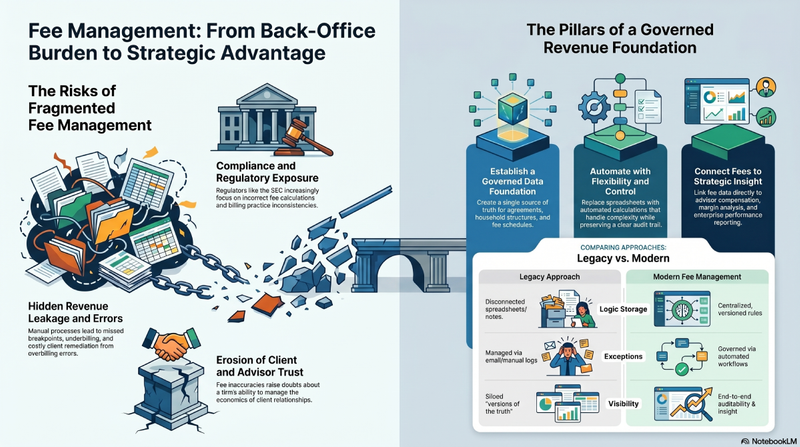
In a small advisory practice, fees may be relatively simple. Enterprise wealth firms, broker-dealers, RIAs, asset managers, and asset servicers operate in a very different environment. They may manage tiered schedules, account-level and household-level pricing, negotiated arrangements, excluded assets, legacy agreements, and advisor-specific compensation plans.
The practical challenge is that fee logic rarely lives in one clean place. Agreements, CRM, billing systems, spreadsheets, advisor notes, finance reports, and compliance reviews can all contain different fragments of the truth. When those pieces are disconnected, fee management becomes an exercise in interpretation.
That creates risk on both sides of the ledger. Firms may underbill and lose revenue they have earned. They may overbill and create client remediation, regulatory, or reputational exposure. They may bill correctly but lack the documentation to prove it quickly. For firms trying to grow efficiently, that is an expensive way to operate.
Fee accuracy is a client trust issue and a compliance issue
Advisory fees sit directly at the intersection of client value, disclosure, and fiduciary responsibility. Clients may not understand every detail of a billing calculation, but they expect the fee to match the relationship, agreement, service model, and disclosures. When a fee error surfaces, the issue is rarely limited to the dollar amount. It raises a more sensitive question: can the firm be trusted to manage the economics of the relationship accurately?
Regulators have also kept a consistent focus on advisory fee and expense practices. SEC examination staff has highlighted issues such as incorrect fee calculations, billing practices that did not match advisory agreements or disclosures, improper application of discounts or breakpoints, and weaknesses in policies and procedures. That makes fee management a governance matter, not just an operational one.
Strong fee management gives firms a clearer line of evidence. Teams can show which agreement applied, which data was used, which fee rule was active, and how exceptions were approved. That evidence matters for client service, audit readiness, and regulatory response.
Fee management shapes margin, advisor behavior, and growth capacity
Fees are not only collected revenue. They are a signal of how well the firm monetizes value.
When firms lack fee visibility, they often struggle to understand where margin is being protected and where it is being given away. Discounts may accumulate without clear approval. Legacy fee schedules may persist long after the business has changed. Advisors may negotiate pricing without understanding how that pricing affects firm economics. Operations may correct errors after the fact, but leadership may never see the patterns behind the corrections.
Fee management helps connect operational accuracy to commercial performance. It gives CFOs a clearer view of leakage and margin impact, COOs a more scalable process, technology leaders a roadmap for reducing fragmentation, and advisors more confidence when explaining value to clients.
This is also why fee management is closely connected to billing and revenue management. Billing converts fee logic into collected revenue. Revenue management connects that billing activity to compensation, reporting, governance, and performance insight. Fee management keeps the fee logic itself accurate, current, controlled, and explainable.
Common problems when fee management is weak
The most common fee management problems often appear as small exceptions, manual reviews, or recurring “known issues” that the organization has learned to tolerate.
One common problem is fee schedule drift. A client agreement changes, but the operational billing rule is not updated everywhere. A legacy rate remains active because no one owns the end-to-end lifecycle of the fee rule.
Another problem is inconsistent householding. Many firms price based on total relationship value, but household structures change constantly. If householding data is inaccurate, breakpoints may be applied incorrectly.
A third problem is unmanaged exceptions. If waivers, rebates, exclusions, and credits are handled through email or spreadsheets, the firm loses visibility into why the exception exists, who approved it, whether it should expire, and how it affects revenue.
A fourth problem is weak reconciliation. Billing outputs need to align with accounting, client reporting, advisor compensation, and management reporting. When each team reconciles from its own extract, the firm creates competing versions of the truth.
A fifth problem is poor explainability. The firm may be able to generate an invoice, but struggle to explain the calculation in a way that satisfies the client, advisor, finance, compliance, and audit teams. In a highly regulated environment, that is a serious weakness.
Finally, weak fee management creates strategic drag. Firms delay pricing innovation, struggle to integrate acquired books, and lack confidence in fee profitability by segment, channel, advisor, or product.
What good fee management looks like
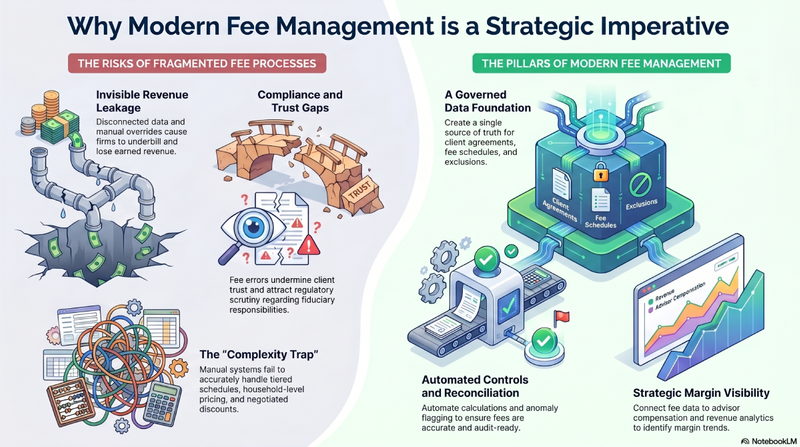
Good fee management starts with a simple operating principle: every fee should be accurate, governed, explainable, and connected to the broader revenue lifecycle.
That requires more than a billing calendar. It requires integrated data, rules, workflows, controls, and reporting.
Start with a governed fee data foundation
Firms need a reliable source of truth for client, account, household, advisor, asset, product, agreement, and fee schedule data. Without that foundation, even the best billing engine will produce inconsistent results.
Good fee management makes the fee rule explicit: which schedule applies, when it became effective, what assets are included or excluded, how breakpoints are calculated, which discounts apply, and which exceptions require review.
Standardize fee rules without eliminating flexibility
Wealth firms need flexibility. Not every client relationship is identical, and not every advisory program should follow the same pricing structure. The goal is not to eliminate variation. The goal is to govern it.
Standardized fee management lets firms support complex fee structures while maintaining control. Rules should be configurable, versioned, testable, and traceable. Exceptions should be approved through workflow, not buried in spreadsheets.
Automate calculation, approval, and reconciliation
Automation should reduce manual work, but its bigger value is control. A modern fee management process should automate fee calculations, flag anomalies, route exceptions for approval, reconcile results, and preserve an audit trail.
For operations teams, that means fewer cycle-end fire drills. For finance, it means more confidence in the numbers. For compliance, it means better evidence. For advisors, it means fewer billing questions.
Connect fee management to compensation and revenue insight
Fees do not stop at billing. They affect advisor payouts, branch performance, margin analysis, revenue leakage, pricing strategy, and enterprise value. A strong fee management approach connects fee data to the systems and teams that depend on it.
When fee management is connected to advisor compensation, firms can reduce disputes and shadow accounting. When it is connected to revenue analytics, leaders can see where pricing discipline is working, where leakage is recurring, and where commercial strategy needs adjustment.
How to approach fee management
The best starting point is a practical assessment of the current fee lifecycle. Map how a fee moves from client agreement to operational rule, billing, collection, adjustment, compensation, accounting, and reporting.
Then look for the breaks. Where is fee data manually entered? Where are exceptions stored? Where do teams reconcile outside the system? Where do advisors challenge results? Where does leadership lack visibility?
From there, prioritize the highest-value use cases:
- Standardizing fee schedules and billing rules
- Improving householding and breakpoint accuracy
- Reducing underbilling, overbilling, and revenue leakage
- Automating exception approval and audit trails
- Connecting fee billing with advisor compensation
- Improving reconciliation to accounting and reporting
- Supporting new pricing models without adding operational risk
- Creating executive visibility into margin and fee performance
The goal is not another isolated technology project. The goal is a stronger revenue operating foundation that helps the firm bill accurately, govern confidently, and grow without unnecessary operational drag.
Fee management is becoming a strategic capability
Wealth and asset management firms are under pressure to grow organically, defend margin, improve transparency, retain advisors, and satisfy higher expectations from clients, boards, and regulators. Fee management sits underneath all of those priorities.
When fee management is weak, revenue leaks, exceptions multiply, advisors lose confidence, and leadership lacks a reliable view of fee performance. When it is strong, firms protect earned revenue, improve control, support pricing discipline, and make better decisions across the revenue lifecycle.
For wealth and asset management firms ready to modernize fee operations, PureFacts helps connect fee billing, compensation, and revenue intelligence through a governed revenue foundation built for complex financial services environments.
FAQs
What is a fee management system?
A fee management system is software that helps financial services firms define, calculate, manage, bill, reconcile, and report client fees across accounts, households, portfolios, and investment programs. Modern fee management systems automate complex billing rules, tiered fee schedules, breakpoints, discounts, exclusions, and exceptions while providing audit trails and reporting. For wealth and asset management firms, a fee management system helps improve fee accuracy, reduce revenue leakage, and strengthen operational controls.
What is a fee management rebate?
A fee management rebate is a fee adjustment, credit, or reimbursement applied to a client account after fees have been calculated or collected. Rebates may be used to honor negotiated pricing agreements, correct billing discrepancies, apply relationship discounts, or accommodate specific client arrangements. Effective fee management solutions help firms automate rebate calculations, approvals, tracking, and reporting to ensure transparency and compliance.
Are there fee management solutions that support multiple currencies and global fee billing?
Yes. Many enterprise fee management solutions support multi-currency fee calculations, billing, invoicing, and revenue reporting across global client bases. Multi-currency fee management capabilities allow firms to calculate fees in local currencies, apply foreign exchange rules, reconcile billing data across jurisdictions, and report revenue consistently. For firms operating internationally, multi-currency fee billing reduces operational complexity and improves billing accuracy.
What is the difference between a management fee and an advisory fee?
A management fee is typically charged for overseeing investments, portfolios, or assets on an ongoing basis and is often expressed as a percentage of assets under management (AUM). An advisory fee generally refers to compensation paid for financial planning, investment advice, and ongoing client relationship services. In many wealth management programs, the terms are used interchangeably, but advisory fees may include broader services beyond portfolio management.
What is the best software for fee management?
The best fee management software depends on your firm's size, complexity, regulatory requirements, and billing model. Organizations should evaluate solutions based on automation capabilities, fee calculation flexibility, auditability, integration support, reporting, and scalability. For wealth and asset management firms, modern fee billing platforms can help reduce revenue leakage, automate fee collection, streamline billing operations, and improve fee governance. Solutions such as PureFacts Fees & Billing are designed specifically to support complex fee structures, advisor compensation workflows, and enterprise-scale fee management requirements.
What is the difference between a management fee and a performance fee?
A management fee is a recurring fee charged for managing assets, regardless of investment performance. A performance fee is an additional fee earned when investment returns exceed a predefined benchmark, hurdle rate, or performance objective. Management fees provide predictable revenue for firms, while performance fees align compensation with investment results. Many institutional investment strategies, hedge funds, and alternative investment products use a combination of management and performance fees.
How can I streamline recurring fee collection?
Recurring fee collection can be streamlined by automating fee calculations, billing schedules, invoice generation, payment processing, exception management, and reconciliation workflows. Firms that rely on spreadsheets or manual processes often face delays, inconsistencies, and increased operational risk. Solutions like PureFacts Fees & Billing help firms automate recurring fee collection while improving fee accuracy, reducing manual effort, maintaining audit trails, and providing greater visibility into fee revenue across the organization.
What is the difference between a management fee, expense ratio, and trailer fee?
These fees serve different purposes within investment products and wealth management relationships: 1. Management Fee: Compensation paid to the investment manager for managing assets or portfolios. 2. Expense Ratio: The total annual operating cost of a mutual fund or investment fund, including management fees and other fund expenses. 3. Trailer Fee: An ongoing commission paid by a fund provider to an advisor or dealer for servicing and maintaining client relationships. Understanding how these fees interact is important for transparency, fee disclosure, and evaluating the total cost of investment ownership.
How can small businesses automate fee management?
Small businesses can automate fee management by implementing software that centralizes fee schedules, automates recurring billing, tracks adjustments, manages invoices, and provides reporting. Automation reduces manual errors, improves cash flow visibility, and helps ensure clients are billed consistently. As businesses grow, automated fee management solutions can also support more complex pricing models, recurring fee collection, revenue tracking, and audit requirements without significantly increasing administrative workload.
Why is fee management important for revenue growth and preventing revenue leakage?
Fee management plays a critical role in protecting revenue by ensuring clients are billed accurately according to their agreements. Weak fee management processes can lead to underbilling, overbilling, missed breakpoints, untracked discounts, and inconsistent fee calculations. Strong fee management practices help firms reduce revenue leakage, improve billing accuracy, strengthen compliance controls, increase advisor confidence, and provide leadership with greater visibility into fee performance, profitability, and growth opportunities.